

Why the Column Matters
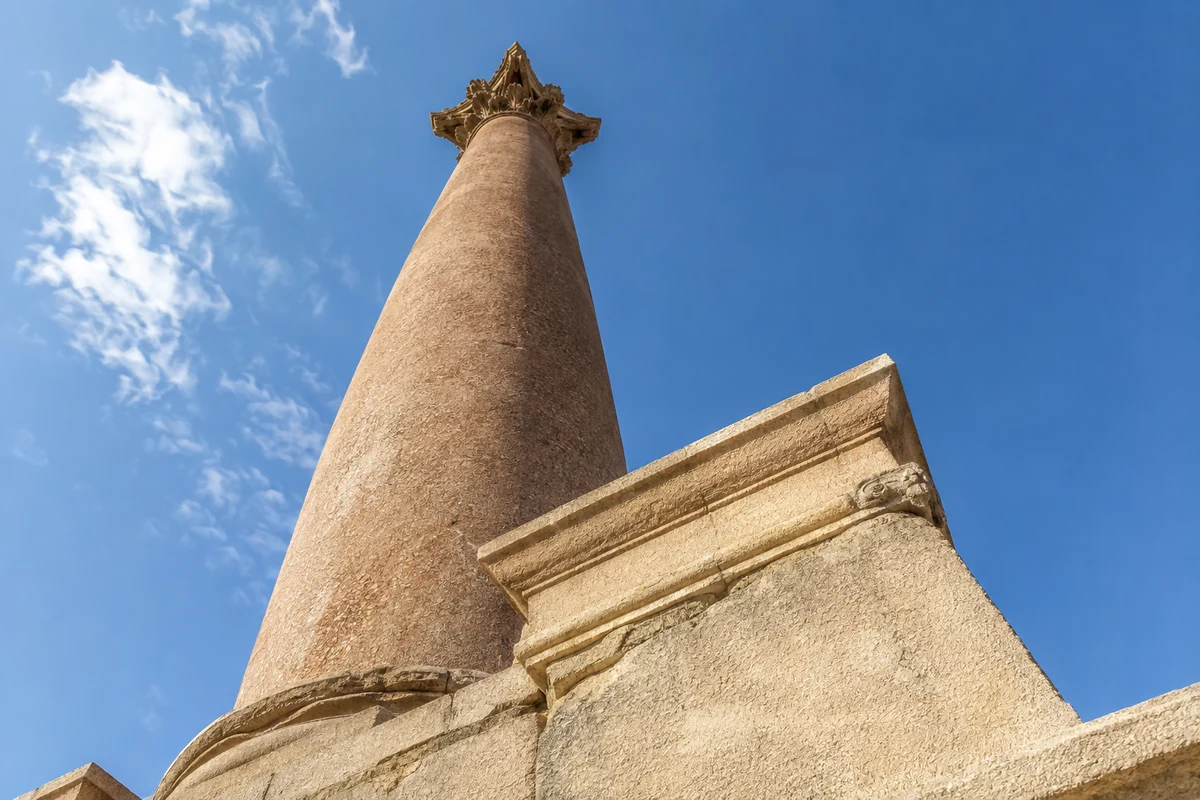
Alexandria’s so-called Pompey’s Pillar is one of the city’s most visible ancient monuments, but its popular name is historically misleading. Egypt’s Ministry of Tourism and Antiquities identifies it as the massive Column of Diocletian, erected in the late 290s AD beside the remains of the Serapeum, the principal sanctuary of Serapis in ancient Alexandria.
That correction changes the story. The monument is not a memorial to Pompey the Great, who died in Egypt in 48 BC. It belongs to Roman Alexandria more than three centuries later and must be read together with the sanctuary, the urban quarter of Rhakotis, and the political world of the emperor Diocletian. The column therefore works as a compact lesson in how names, monuments, and historical memory can drift apart.
Alexandria, Rhakotis and the Serapeum
Alexandria was founded by Alexander the Great in 331 BC, beside an older Egyptian settlement known as Rhakotis. The Ministry’s Alexandria overview describes the city as the Ptolemaic capital and one of the most important centers of the eastern Mediterranean for centuries.
The Serapeum rose in the Rhakotis district. The Centre d’Études Alexandrines study of the sanctuary reconstructs several major building phases: early Ptolemaic installations under Ptolemy II, the main Temple of Serapis and a peristyle court under Ptolemy III, and substantial enlargement in the Roman imperial period. The sanctuary was therefore already centuries old when Diocletian’s column was added.
This layered setting is essential. The surviving column dominates the site today, but in antiquity it stood inside a much larger sacred complex. Reading only the column produces a distorted picture; the monument is best understood as the latest monumental statement in a sanctuary with a long Ptolemaic and Roman history.
Engineering and Monumental Form

The column is impressive because of both scale and material. Alexandria’s official heritage portal describes a total height of about 26.85 metres and a monolithic shaft of red Aswan granite more than 20 metres high, with a diameter of roughly 2.7 metres at the base. The shaft is crowned by a Corinthian capital and set on a substantial pedestal.
These dimensions matter visually. A single granite shaft of this scale demanded quarrying, transport, erection, and careful foundation work. The monument also shows how Roman imperial architecture in Egypt could combine local stone resources with Mediterranean architectural vocabulary. The red granite links the structure physically to Upper Egypt, while the Corinthian capital and dedicatory function place it within Roman commemorative practice.
The Centre d’Études Alexandrines notes that ancient representations indicate a porphyry statue of Diocletian originally stood on top. If so, the surviving column is only part of the original composition: the complete monument would have presented the emperor elevated above the Serapeum precinct.
Key Facts to Read On Site
Why It Was Dedicated to Diocletian

The most important evidence for the monument’s identity is the inscription on its base. The Centre d’Études Alexandrines dates the column to AD 297 and connects it with Diocletian’s restoration of imperial control after the revolt of the usurper Domitius. The CEAlex study of the Serapeum places the dedication in AD 297–298.
The inscription therefore anchors the monument in a specific Roman political context. It is not simply a decorative column. It communicated imperial authority inside one of Alexandria’s most important sacred spaces. This combination of religion and power is typical of monumental architecture: the column’s height, material, and elevated statue turned political legitimacy into a visible urban statement.
The later name “Pompey’s Pillar” obscured this evidence for centuries. Modern archaeology and epigraphy reverse that process by returning attention to the inscription, the sanctuary, and the late third-century date.
The Serapeum Around the Column
The column’s surroundings are not secondary scenery. The Serapeum was one of ancient Alexandria’s most famous sanctuaries and the center of the cult of Serapis, a deity whose worship crossed Egyptian and Greek cultural traditions. A major archaeological reassessment published in the Journal of Roman Studies describes the Serapeum as Alexandria’s most important sanctuary and reconstructs its architectural development from the surviving evidence.
The Alexandria heritage portal also records underground galleries, Ptolemaic sphinxes, a Nilometer, and other remains associated with the sanctuary complex. Some older interpretations of the subterranean spaces as a “daughter library” have been questioned; the portal notes that their function is uncertain and may instead relate to sacred-animal burial.
This is a good example of why the site should be approached critically. The Serapeum contains genuine evidence, later traditions, and changing scholarly interpretations. The best visitor experience comes from separating what is physically preserved from what has been proposed.
Historical Names and Misreadings
How to Study the Site Today

Begin by stepping back far enough to understand the column’s vertical scale against the Serapeum plateau. Then move closer to compare the monolithic granite shaft, Corinthian capital, pedestal, and surviving inscription. The physical sequence makes the monument easier to read than a photograph alone.
Next, examine the wider sanctuary remains. The sphinxes, foundations, subterranean spaces, and scattered architectural elements help restore the missing context around the standing column. The site is especially useful when paired with other Roman and Graeco-Roman monuments in Alexandria because it shows a different kind of urban archaeology: not a theatre or tomb, but a sacred precinct transformed by imperial commemoration.
For a broader visit, the Graeco-Roman Museum and Kom el-Dikka can add material and civic context. Check current official access information before travel, because opening conditions and ticketing can change.
Frequently Asked Questions
Is Pompey’s Pillar really connected to Pompey?
No. The surviving inscription and archaeological context identify the monument with Emperor Diocletian in the late third century AD, more than three centuries after Pompey’s death.
When was the column erected?
Specialist studies place the dedication in AD 297–298, during the reign of Diocletian and after Roman imperial control was restored in Alexandria.
How tall is Pompey’s Pillar?
The monument is about 26.85 metres high including its base and capital. Its monolithic red-granite shaft rises for more than 20 metres.
What is the column made from?
The shaft is a single piece of red Aswan granite. It is topped by a Corinthian capital and stands on a large pedestal.
Gate East can help organize an Alexandria itinerary that connects Roman archaeology, museums, coastal landmarks, and realistic travel time. Add the Serapeum and Diocletian Column to a private Egypt journey with practical planning support.


Comments & Travel Questions
Share a question, travel note, or feedback about this guide.