
Why Esna Temple Matters

Esna Temple is one of the clearest places to study how Egyptian temple architecture and hieroglyphic religion continued under Roman rule. The University of Tübingen Esna Project, working with Egypt’s Ministry of Tourism and Antiquities, identifies the surviving building as the pronaos, or columned front hall, of a larger temple whose construction began in the Ptolemaic Period and continued into Roman times.
For travelers, the value of Esna lies in concentration. Architecture, color, astronomical imagery, ritual scenes, and unusually dense religious texts survive together inside one monumental hall.
The Surviving Roman Pronaos
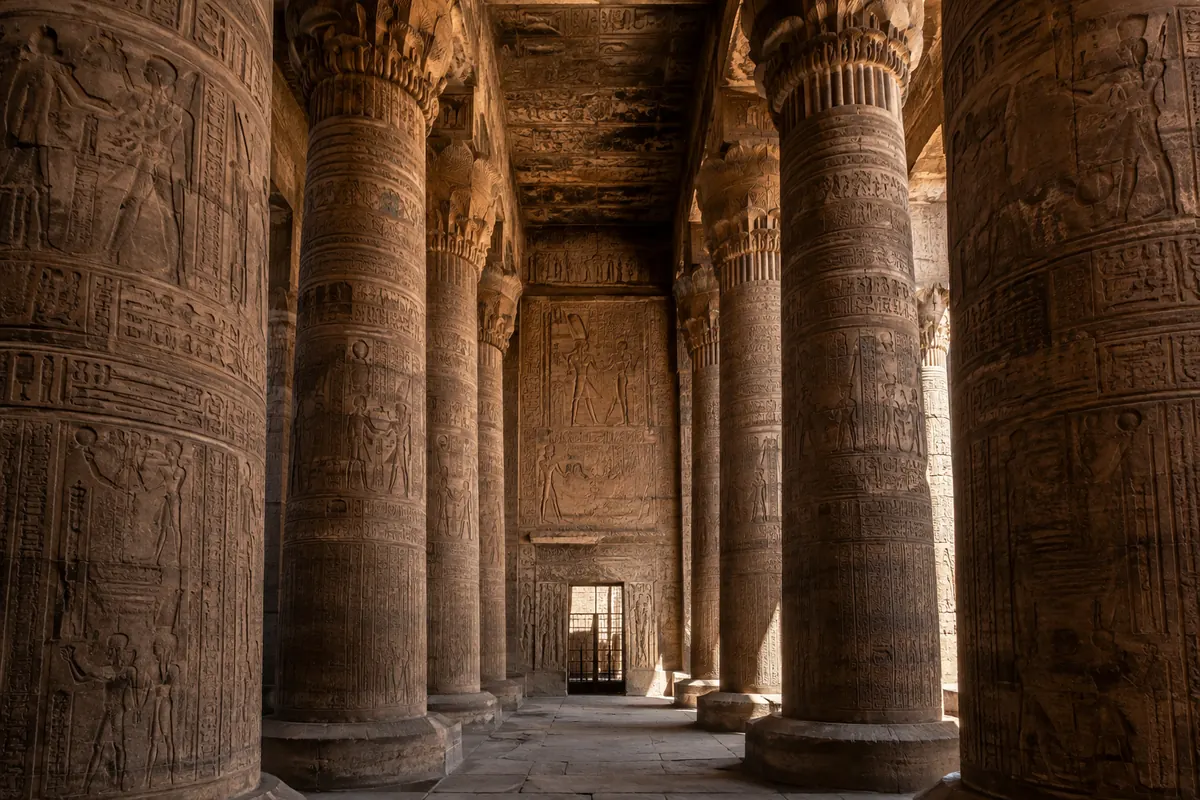
The main temple building no longer survives, but its imposing front hall does. Research summarized by the University of Tübingen describes the pronaos as roughly 37 metres long, 20 metres wide, and 15 metres high. Its roof is carried by 24 columns, creating a compressed forest of stone rather than a long open-axis experience.
The vestibule was built under the Roman emperor Tiberius, while decoration continued for more than two centuries, into the reign of Decius. For broader route context, Gate East’s Nile Valley Travel Guide helps place Esna between the better-known temple landscapes around Luxor, Edfu, and Aswan.
Columns as Architecture and Text

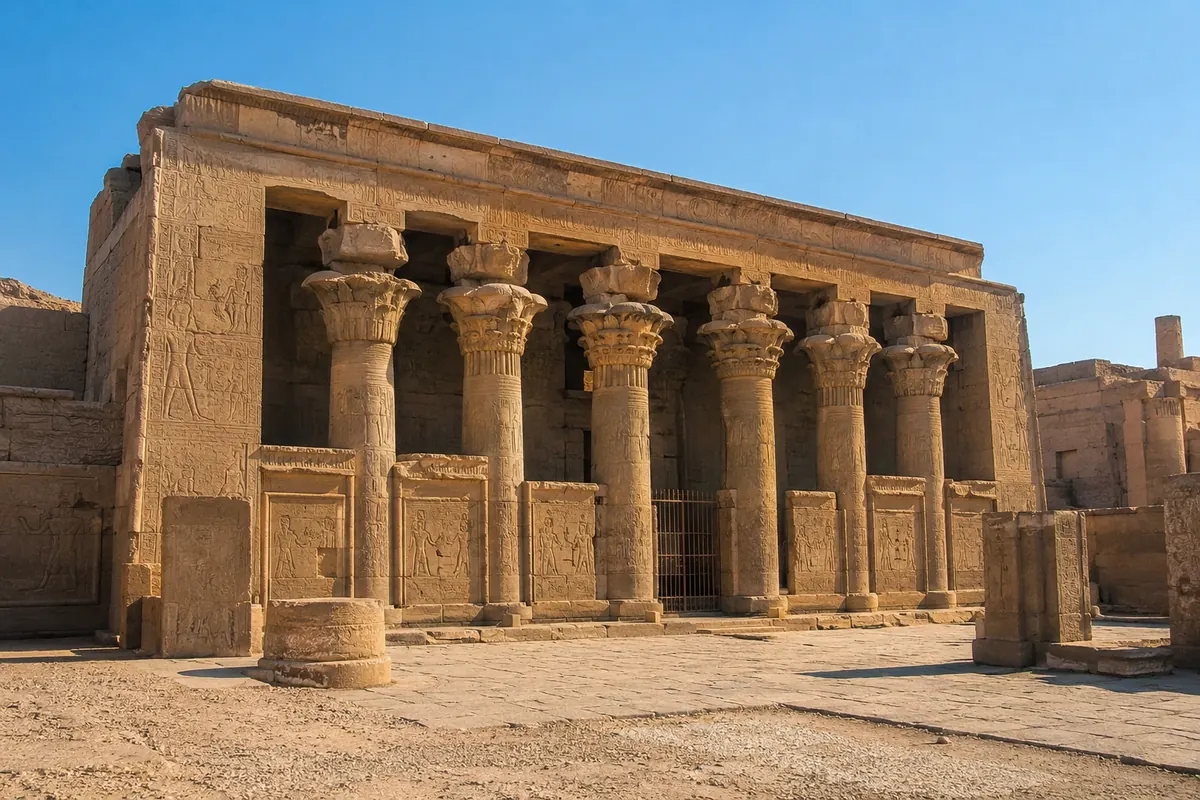
The columns at Esna are not simply structural supports. Eighteen freestanding columns carry varied plant-form capitals, while their shafts and upper blocks are covered with inscriptions and reliefs. The IFAO publication Esna III records the hieroglyphic texts on the shafts of these eighteen columns and treats them as a major source for local theology and ritual.
The newer Multidimensional Philology project goes further by stressing that the placement of a spelling, phrase, or sequence within the pronaos can affect its meaning. At Esna, architecture and writing must therefore be read together. Gate East’s Luxor destination guide provides useful regional context for comparing this late temple with earlier monuments nearby.
Architectural Details to Read
Religious Texts and Local Theology

Esna’s inscriptions are among the youngest and most extensive self-contained hieroglyphic corpora to survive. The University of Tübingen philology project notes their highly local writing system, which could use deliberately ambiguous spellings for divine names, sacred materials, and place names. This was learned temple writing, not random complexity.
Serge Sauneron’s Esna V study of religious festivals shows how the inscriptions preserve a rich ritual calendar and themes including the cult of Khnum, New Year ceremonies, royal birth, dead gods, and Osirian traditions. The texts make Esna especially important for studying the final centuries of active Egyptian temple theology.
Color, Ceiling and Restoration
Modern conservation has transformed how Esna can be read. Since 2018, the Egyptian-German project has removed heavy soot and dirt from columns, walls, and the ceiling, revealing strong reds, blues, yellows, and greens. The ceiling restoration report documents hundreds of astronomical figures, while the project has also cleaned the complete astronomical ceiling and the eighteen inner columns. The restored color shows that text and image were designed as a vivid visual system, not bare stone decoration.
Practical Travel Tips
Place Esna in a Nile Valley Route
Esna works best as part of a southbound or northbound Upper Egypt sequence rather than as an isolated detour. From Luxor, the site can introduce the late development of temple architecture before continuing toward Edfu and Kom Ombo, where visitors can compare different plans, divine cults, and decorative programs.
A slower route gives enough time to notice how Esna differs from the monumental scale of Karnak or Edfu. Its strength is the density of the surviving pronaos: columns, color, astronomy, and learned inscriptions can all be studied within a compact architectural space.
Frequently Asked Questions
What survives of Esna Temple today?
The surviving monument is mainly the pronaos, the large columned front hall of a broader temple complex. The main temple building itself has disappeared, leaving this Roman-period architectural and epigraphic section as the principal visible structure.
When was the surviving pronaos built?
The surviving vestibule was built under the Roman emperor Tiberius in the first century CE. Its reliefs, inscriptions, and painted decoration continued to develop for more than two centuries, with some texts dating as late as Decius.
Why are the columns at Esna important?
They combine structure, sculpture, color, and writing. Eighteen freestanding columns have varied plant capitals, and their shafts carry extensive hieroglyphic texts that preserve evidence for local theology, ritual, and the relationship between language and architectural placement.
What do Esna’s religious texts discuss?
The corpus includes hymns, ritual material, festival calendars, local theology, creation themes, New Year ceremonies, royal birth, and Osirian traditions. Their unusual spellings also reveal a highly sophisticated late tradition of temple writing.
Gate East can help shape a private Nile Valley itinerary that includes Esna alongside Luxor and other temple sites, with pacing tailored to your interest in architecture, inscriptions, and ancient Egyptian religion.


Comments & Travel Questions
Share a question, travel note, or feedback about this guide.